Deck Material Calculator — Lumber & Hardware
Enter the deck size and how you plan to frame it. Every line comes back as a purchase quantity: whole boards, whole bags, and the stock length to buy them in.
Decking Boards
29
16 ft boards, 10% waste included
Deck Area
192
sq ft · 26 board rows · 416 lineal ft
Footings
4
16 in diameter · 36 in deep
Material list
| Item | Size | Qty | Length |
|---|---|---|---|
| Decking boards 26 rows of 1 across 12 ft at 3/16 in gaps, plus 10% waste | 2x6 wood decking | 29 | 16 ft |
| Joists 16 ft at 16 in o.c., plus one end joist | 2x10 | 13 | 12 ft |
| Ledger board Same size as the joists, bolted to the house band joist | 2x10 | 1 | 16 ft |
| Rim joist One rim closes the outer end of the joists | 2x10 | 1 | 16 ft |
| Beam plies 1 beam of 2 plies — the span between posts is not sized here | 2x10 | 2 | 16 ft |
| Posts 4 per beam at 5.3 ft on center, bought long enough to trim | 6x6 | 4 | 8 ft |
| Footing form tubes One per post, 36 in deep, sized for the 32.0 sq ft the worst post carries | 16 in diameter | 4 | — |
| Concrete, 60 lb bags 10 per footing — buy this size or the 80 lb, not both | — | 40 | — |
| Concrete, 80 lb bags 7 per footing — buy this size or the 60 lb, not both | — | 28 | — |
| Joist hangers One per joist at the ledger | 2x10 | 13 | — |
| Joist-to-beam connectors One per joist where it lands on the beam | 2x10 | 13 | — |
| Post bases One per post, anchored to the footing | 6x6 | 4 | — |
| Post caps One per post, tying the post to the beam | 6x6 | 4 | — |
| Ledger fasteners (1/2 in lag screw) 15 in on center for a 12.0 ft joist span, per IRC 2021 Table R507.9.1.3(1) | — | 14 | — |
| Decking screws 2 per board at every joist, counting both boards where a row is spliced, plus 10% waste | — | 744 | — |
This list does not size the beam: you choose the ply and the size, and the span between posts is sized by the deck beam calculator, which reads IRC 2021 Table R507.5 at the effective joist span. Stairs and railing are not in the list — the deck stair calculator and the deck railing calculator cover those. The list is quantities only — it stops at what to buy and says nothing about money.
What the material list covers
The list is built in the order a deck goes together. Decking is counted by rows across the deck and boards along it. Joists, ledger, and rim are the joist size at the stock length that covers the run. Beams are the ply count you chose, one run per beam. Posts are one per bay along each beam plus the post that closes it, and each post gets a footing, a base, and a cap. Hardware closes it out: hangers where the joists meet the ledger, connectors where they meet a beam, ledger fasteners, and decking screws.
Every quantity is what you would buy, not what you would use: whole boards, whole bags, and stock lengths taken from the 8, 10, 12, 14, 16, 20 ft framing list and the 8, 10, 12, 16, and 20 ft decking list. Square feet and lineal feet appear only as summary figures, never as something to carry to the yard.
Three things are deliberately outside it. This list does not size the beam: you choose the ply and the size, and the span between posts is sized by the deck beam calculator, which reads IRC 2021 Table R507.5 at the effective joist span. Stairs and railing are not in the list — the deck stair calculator and the deck railing calculator cover those. The list is quantities only — it stops at what to buy and says nothing about money.
How the decking count works
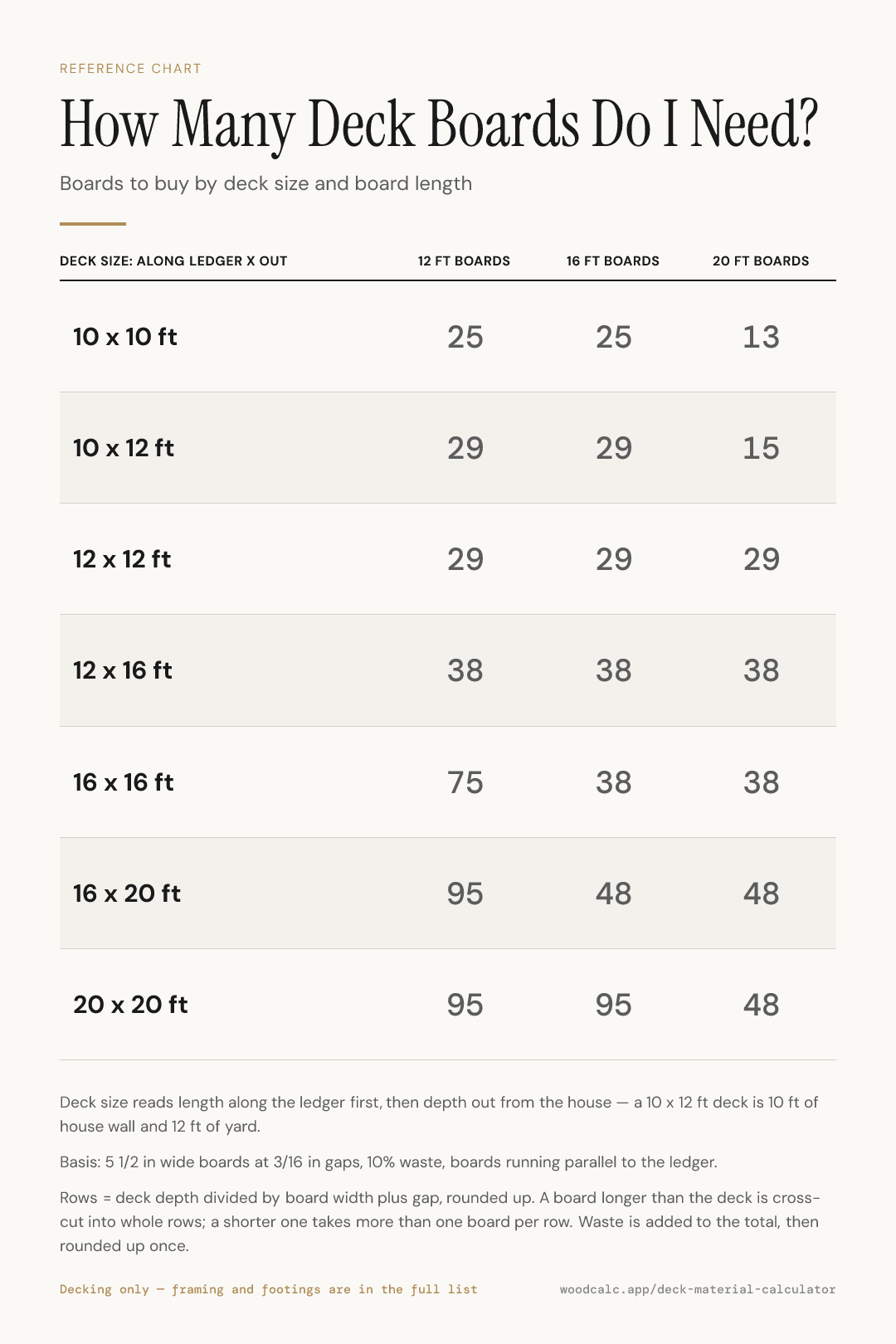
Boards run parallel to the ledger, so a row is one deck length long and rows stack across the depth. The row count is the deck depth divided by the board width plus the gap, rounded up — a 5 1/2 in board with 3/16 in gaps covers 5 11/16 in per row, so a 12 ft deep deck takes 26 rows.
Then the rows are cut from stock. A board at least a deck length long is cross-cut into whole rows: a 20 ft board makes 2 rows of a 10 ft deck. A board shorter than the deck takes more than one per row, with the joint landing on a joist — a 16 ft deck framed with 12 ft boards buys 2 boards for every row, and the leftover from each is waste rather than being spliced into the next row. Offcuts are never carried between rows, which is what keeps the count a purchase quantity.
The waste allowance multiplies what the deck needs, and the rounding up to whole boards happens once, afterwards. What the deck needs is not always a whole number: a 10 ft by 20 ft deck takes 43 rows at 2 rows a board, which is 21.5 boards, and 10% on that buys 24. Rounding to whole boards first and adding waste after would round twice and buy one more.
Download the deck board count chart (PNG) — common deck sizes against 12, 16, and 20 ft boards, on the same basis. Each size on it is written as the length along the ledger by the depth out from the house, in that order.
Where the joist and footing lines come from
This page works out neither of them. It hands your deck depth, species group and spacing to the deck joist calculator and prints the row that comes back, so the two pages can never disagree. If that calculator has no answer — the depth is past what it covers, or the cantilever you asked for is — the list says which, and leaves the joist, ledger, rim, and joist hardware blank rather than printing a number nothing stands behind.
The footing row works the same way, with one piece of geometry supplied from here: how much deck a single post carries. A beam takes half the joist span behind it plus the whole cantilever in front, and an interior post takes half a bay on each side of it; the worst post's share is what goes to the deck footing calculator, and every footing is bought alike so none is under-built. Concrete comes back as whole bags — 60 lb or 80 lb, per footing and in total.
Posts, footings, and ledger fasteners
Posts are spaced along each beam at no more than the spacing you pick, so the count is the deck length divided by that spacing, rounded up, plus one. The actual spacing is then the deck length divided by the bays, which is always at or under the maximum. The length to buy is the shortest stock post that reaches the deck height above grade: an 8 ft post for anything up to 8 ft. That is deliberately long — the post actually runs from the top of the footing to the underside of the beam, which is a beam depth, a joist depth, and a board thickness below the deck surface, so the deck height always leaves something to trim. Above 16 ft the list states no length at all and flags a special order, because no stock length would be true. A joist longer than the framing stock lengths is handled the same way: the row keeps its count and drops its length.
Ledger fasteners follow IRC 2021 Table R507.9.1.3(1), which sets the on-center spacing from the joist span. The count assumes the 1/2 in lag screw column with 1/2 in maximum sheathing — the tightest of the table's three columns, so the count is never short if you use 1/2 in through bolts instead, which the table lets you space further apart. A fastener lands at each end of the ledger plus one per space, and the table stops at a 18 ft joist span; past that the list withholds the count.
Decking screws are 2 at every place a board crosses a joist, and a spliced row crosses the joist under its joint twice — once for each board end — so every splice adds a crossing. The total is grown by the same waste allowance as the boards.
Frequently asked questions
- How much lumber do I need for a deck?
- It depends on the deck size and how it is framed. A 16 by 12 ft deck (192 sq ft) attached to the house, framed in Southern pine at 16 in on center, needs 29 2x6 wood decking boards at 16 ft, 13 2x10 joists at 12 ft, a ledger and a rim, 2 2x10 beam plies, 4 6x6 posts, and 4 footings. Change any input and the whole list is recalculated.
- How many deck boards do I need?
- Rows first, then boards. The rows are the deck depth divided by the board width plus the gap, rounded up: at 5 1/2 in wide with 3/16 in gaps, a 12 ft deep deck takes 26 rows. Then each row is cut from stock: a board longer than the deck yields whole rows, a shorter one takes more than one board per row. Waste is added to the whole-deck total and rounded up once, so 10% waste on 26 boards buys 29.
- Where do the joist and footing lines come from?
- They are not worked out here at all. This page hands your deck to the deck joist calculator and the deck footing calculator and prints what each one returns, so the list can never disagree with either of those pages. When one of them declines to answer, the row comes back blank with a note rather than guessed.
- Does the material list cover the beam, the stairs, and the railing?
- No. This list does not size the beam: you choose the ply and the size, and the span between posts is sized by the deck beam calculator, which reads IRC 2021 Table R507.5 at the effective joist span. Stairs and railing are not in the list — the deck stair calculator and the deck railing calculator cover those. The list is quantities only — it stops at what to buy and says nothing about money.